Nicaragua Solidarity Coalition 2.10.2026: Sandinista Nicaragua, 19 Years Revolutionizing
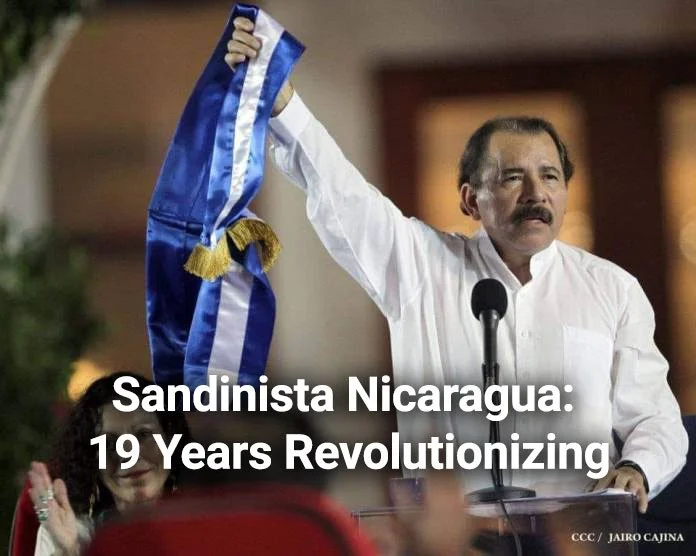
Fabrizio Casari: Sandinista Nicaragua: 19 Years Revolutionizing The moment Commander Daniel Ortega was proclaimed President on January 10, 2007, he declared it was the people who had assumed the presidency. The objective was—and remains—to lift as many people as possible out of poverty in the shortest possible time; to build a national project based on harnessing its resources for the benefit of the entire population.
Between 2007 and 2025, absolute poverty fell from 17.5% to 6.9%, and relative poverty from 48.3% to 24.9%. In a country where, until 2007, only 54% of the territory had electricity, today that figure has reached 99.5%, with most of it generated from renewable sources. The number of hospitals has increased from 33 to 77. From 2,044 kilometers of paved roads in 2007, now there are 5,289 kilometers, with 95% of municipalities connected to the national road network—crucial links for the growth of the regional economy. Maternal mortality has fallen from 93 to 16 per 100,000 live births, and infant mortality from 29 to 9.5 per 10,000 live births. Unemployment stands at 2.4% and inflation under 3%. .All of this has produced in these 19 years an average annual growth of 4-4.5%. Sandinismo has proven to be, above all, a vision of nation, people, and society that incorporates the best aspirations of socialism within a capitalist economy.
John Perry: Nicaragua’s Economy “Weathers Multiple Shocks,” Including US Attacks The International Monetary Fund’s new assessment of Nicaragua’s economy labels it as “strong” no fewer than 56 times. But it also shows how key factors in the country’s growing prosperity – export earnings, trade relations and remittances (money sent by Nicaraguans living abroad) are vulnerable to US attacks.
Nicaragua’s relative strength can be seen from the table comparing it with its neighbors: despite being the region’s lowest-income country, it fares better than Honduras in productivity, has low debt and the lowest cost of living (using an established international index). Indeed, a prosperous Nicaragua is key to regional stability: it receives 28% of its imports from Central America and contributes 16% of its exports. It is also a recognized bulwark against regional organized crime and drug trafficking.
Nicaragua’s economy could be vulnerable to US attacks or policy changes in three main ways. First, its exports are heavily dependent on trade with the US despite Trump’s recent tariffs. Second, remittances from Nicaraguans living abroad are a very significant contributor – around a quarter – to Nicaragua’s annual income (the same applies in Honduras and El Salvador). This could change rapidly if migrants now in the US are deported or return to Nicaragua. Third, loans from multilateral bodies such as the World Bank, in practice these continue to be blocked by US sanctions.
Stephen Sefton: Nicaragua as a regional model Nicaragua's productive economy is highly competitive with the economies of its neighboring countries, while its public sector responds much better to the aspirations of the families of the vast majority of its population. At the regional level, among many other indicators, Nicaragua has the best roads, by far the largest number of hospitals in the public system, the best citizen security, the best agricultural and livestock health system and the best disaster prevention system. The nominal figures for poverty in Central America indicate that Honduras and Guatemala have the highest percentages, above 45% in each country, while Nicaragua, El Salvador and Costa Rica have levels of about 14%.
This enormous effort of the public sector led by Comandante Daniel and Compañera Rosario has ensured that Nicaragua acts as a strong influence for regional economic stability. Nicaragua's Trade Ministry reports that Nicaragua receives 28% of its imports from Central America, which is also the destination of 16% of our country's exports. It is indisputable that only the Sandinista Popular Revolution could have made it possible for Nicaragua to achieve so many socio-economic victories in just 20 years after the catastrophe of 17 years of misrule by neoliberal administrations that served the US empire.
Augusto C. Sandino, Nicaragua's National Hero by Mikhail Ledenev, Ambassador of Russia to the Republic of Nicaragua. Ledenev reviews Sandino’s life, his place in the 20th century anti-imperialist struggle, his connections with the Soviet Union. He then continues with Carlos Fonseca, and then summarizes Nicaragua’s relations with the Soviet Union and later, Russia.
Upcoming Events
February 13 (zoom), 8:30am ET: Convocatoria Internacional de la Clase Obrera. Videoconferencia Internacional por la Liberación del Presidente Nicolás Maduro Moros y de la Primera Dama, Diputada Cilia Flores. https://us06web.zoom.us/j/86578867391?pwd=Phbp0w2raDfxXKba8iH1gnaiBHxegw.1
February 15, 2-4 pm ET: webinar Cuba Under Siege featuring a speaker from Cuba’s Permanent Mission to the United Nations & organizers from labor unions and solidarity groups
March 14-15 conference (NYC): Cuba under Siege: Stop US Military Intervention in the Americas! Defend Venezuelan Sovereignty! Welcome to the Delegation from Cuba attending the United Nations Commission on the Status of Women
Sarah Woodard 2026 U.S. Speaking Tour, March 10 – May 20. To invite her, or to send questions or offers of travel help (e.g., airplane miles), email sarah@jhc-cdca.org. Sarah Woodard represents the work of the Jubilee House Community, a nonprofit she helped form in 1979. She has worked the last 32 years in Nicaragua, with the Center for Development in Central America. The JHC-CDCA continues to respond to local needs, seeking resources to help the poor accomplish what they see as their priorities, particularly in the areas of sustainable economic development, organic agriculture, health care, and education. Now, with the world in chaos, Sarah’s U.S. tour is focusing on educating those in the global north on the amazing realities developing within Nicaragua where the social and political will is aimed at helping the majority of the population, the poorest of the poor. The preliminary tour schedule: https://www.jhc-cdca.org/blog/spring-2026-speaking-tour.
Delegations to Nicaragua:
Casa Ben Linder Email casabenjaminlinder@gmail.com to apply:
21 May - 2 June 2026 Mayo Ya! Celebrating Afro-Caribbean Culture. Join us in Bluefields for the Mayo Ya celebrations featuring street dances, parades and traditional music to welcome the rainy season. Application deadline March 1st.
July 2026: Solidarity in Action: Nicaragua’s Popular Revolution
October 2026: Salud & Solidaridad: Hands-On Healthcare in Nicaragua
Now offering Spanish classes! Fun and practical language classes at Casa Ben Linder – our
model teaches 1/2 day class & 1/2 day practice in a community setting.
.
Nicaragua Solidarity Coalition: nicasolidarity.com
Sign up to receive the Nicaragua Solidarity Coalition bi-weekly newsletter, action alerts, event notifications: bit.ly/NicaSubs
Listserve: nicanet@googlegroups.com join at groups.google.com/g/nicanet
Weekly Nica Notes:https://afgj.org/signup
Facebook: Friends of Sandinista Nicaragua, Nicaragua Solidarity Coalition
Twitter: @SolidarityNica
Instagram: @NicaSolidarity
YouTube: @nicaraguasolidaritycoalition
