Myths and Facts about Nicaraguan Democracy
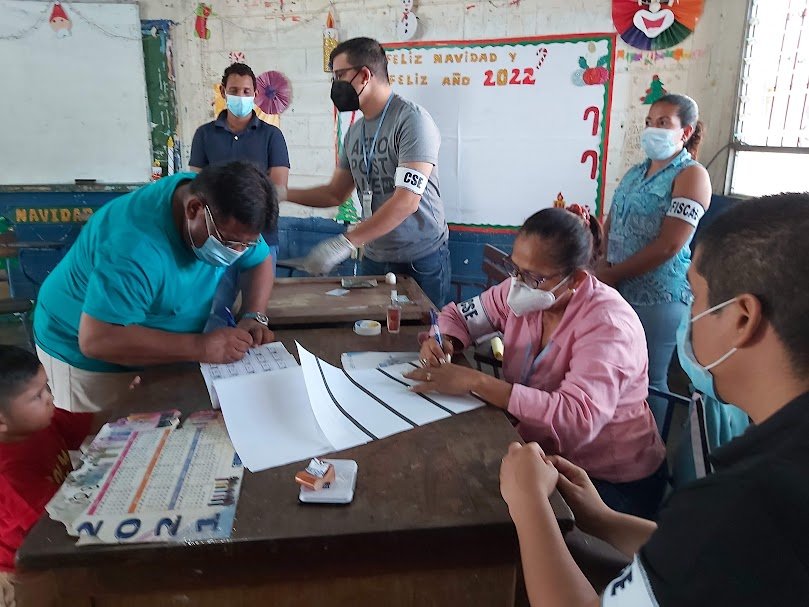
Voters receiving ballots in a polling station during general elections in Leon, Nicaragua on 7 November, 2021.
BY NICARAGUA SOLIDARITY COALITION OCT 2026
MYTH: President Ortega announced on July 19, 2026 that there will no longer be elections in Nicaragua.
FACT: President Ortega actually said that the people of Nicaragua should be free to elect their leaders without interference from the United States or other countries. Previously in the same speech, he cited past examples of U.S. interference. These included foreign funding of campaigns of U.S.-preferred candidates, and threats of sanctions and other aggression if an election did not produce the outcome desired by the U.S.
He also said that certain Nicaraguan persons or organizations should be ineligible to run as electoral candidates or political parties – i.e., those who receive foreign funding, or who conspire to overthrow the government, or who call for sanctions and financial aggression against their own country,
He announced that he would ask the National Assembly to amend the Constitution to protect the country’s elections against these stated threats. The constitutional amendment process is currently underway, with widespread citizen consultations also taking place across the country.
MYTH: There are no elections in Nicaragua.
FACT: There have been democratic elections every five or six years in Nicaragua since 1984. Elections were due to be held in November 2027, but Constitutional amendments proposed this summer would move elected positions to a seven-year cycle. This means that the offices of Co-Presidents, Deputies to the National Assembly, Mayors and other offices would be up for election in late 2028.
MYTH: Daniel Ortega and Rosario Murillo are dictators and do not allow anyone to run against them.
FACT: There are 14 recognized political parties in Nicaragua, and they are all participating in the constitutional reform discussion and vote. Many of them are expected to run presidential candidates in the next election. For the last presidential election in 2021, there were six candidates for President, including Daniel Ortega who led the ticket for a coalition of parties. President Ortega won 75% of the vote in a contest with 65% voter turnout, which is consistent with polls at the time. FSLN approval ratings have gone up since then.
MYTH: There is no freedom of religion in Nicaragua and the government persecutes the Catholic Church.
FACT: Religion is practiced openly and freely in Nicaragua, with numerous colorful religious festivals and processions throughout the year. Some Catholic priests have been convicted of money laundering and promoting violence. Protestant or Evangelical churches now have more congregants than the Catholic Church.
MYTH: Nicaragua is anti-woman because it has outlawed abortion.
FACT: While many Nicaraguans look unfavorably on abortion, the abortion ban that was enacted before the FSLN came back to power is not strictly enforced. Meanwhile, women’s health is prioritized through sexual and reproductive care, free contraception, maternity centers, and special women’s police stations, leading to low rates of maternal mortality and gender-based violence. Nicaragua consistently ranks high in international comparisons of gender parity in health, education, economic opportunity, and political empowerment.
MYTH: Nicaragua poses a threat to the United States.
FACT: Nicaragua is the second poorest country in the hemisphere and has the tenth lowest per capita military spending in the world. It is ridiculous to think that this poor country of 7 million is a threat to the world’s largest military power, which spends almost 10,000 times as much on defense. In addition, the Ortega-Murillo administration constantly expresses the goal of peace for its citizens, brought about through its Government of National Reconciliation and Unity (GRUN).
NICARAGUA IS THE THREAT OF A GOOD EXAMPLE. With military spending minimized, 60% of Nicaragua’s national budget is devoted to social services such as free universal health care and free education through graduate school. Massive hospital and healthcare investment over the past 19 years has left it with the best hospital infrastructure in Central America. It also has the best roads, and thousands of housing units are delivered to families at very low cost every year. Child hunger and illiteracy are virtually eliminated, and Nicaragua’s infant mortality rate is 9 per 1,000 live births, equal to that of Indigenous children in the U.S., and better than that of Black infants in the U.S. Indigenous and Afro-descendant communities on the Caribbean Coast enjoy communal title to one-third of the national territory, and benefit from a system of cultural, political, and legal autonomy. Unlike its neighbors, Nicaragua has low rates of drug trafficking and organized crime, and a homicide rate similar to that of the U.S.
MYTH: Nicaragua is our enemy.
FACT: Co-Presidents Rosario Murillo and Daniel Ortega often talk about their country’s greatest enemy. It is not a person, or a country, or an ideology. It is POVERTY. People in the United States should demand that our government stop blocking loans to Nicaragua that would expand social service programs and bring more people out of poverty. It is time for us to put an end to the colonialist mentality of the Monroe Doctrine and allow the Nicaraguan people to live in peace under the system of government they have chosen.
For more information about Nicaragua today, see: https://www.nicasolidarity.com/ (At a Glance)
