Daniel, The Story of a Comandante
Fabrizio Casari, Radio La Primerísima, January 4, 2026
https://radiolaprimerisima.com/2026/01/04/daniel-historia-de-un-comandante/
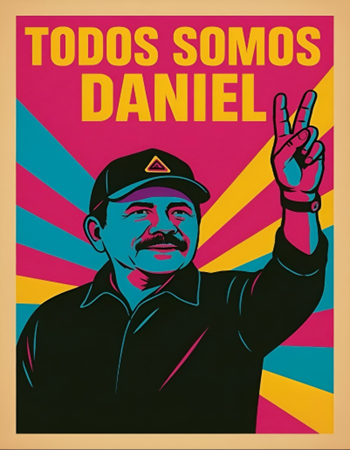
The documentary “Todos Somos Daniel” is a historical narrative combined with cinematography. It seamlessly blends archival footage and interviews with key figures whose names and faces appear only in the end credits. The protagonist is Commander of the Revolution Daniel Ortega Saavedra, the undisputed leader of Sandinismo, past and present. President, of course, to his voters; Commander, to the Sandinistas; Father of the Nation, to all the Nicaraguan people. This writer believes that presidents are presidents during their term; commanders like Daniel are commanders forever.
The documentary unfolds through his life, which, from adolescence, was marked by the struggle against the Somoza dictatorship, with a total commitment to Sandinismo. This led him to fight, to suffer imprisonment and torture, and to be freed thanks to the José Quezada Command, which kidnapped the dictatorship's scum and exchanged for the best sons of Nicaragua.
The story is set against the backdrop of the revolutionary victory, sealed on world calendars on July 19, 1979. Daniel is nominated in the streets by Commander Tomás Borge on behalf of the entire National Directorate and elected by acclamation by a jubilant crowd, thus beginning a new chapter in history. Daniel had already distinguished himself as a tireless leader during the ten years of revolutionary government, a period marked by war and poverty, exacerbated by the United States' efforts to wage further war (the Contra War) and further impoverishment (the embargo).
In 1990, the FSLN was defeated at the polls, but Daniel, instead of returning home as a figure of the 20th-century, decided to resist, to govern “from below.” In 1994, he defeated the conspiracy of the oligarchy representatives disguised as Sandinistas and, despite having almost no parliamentarians or financial and media support, he rebuilt the party precisely from the ground up. The traitors settled into their villas and parties at embassies, but he chose other connections. He comes from those people and speaks to those people: by car, on horseback, on foot, there is no corner of Nicaragua where Daniel will not go to rebuild the political organization and the resistance against neoliberalism, constructing the political and electoral redemption of Sandinismo. Daniel doesn't know the meaning of the word “waver,” but he knows a great deal about tactics and strategy, he knows about victories and the value of achieving them through peace whenever possible.
Marcio and Carlos Vargas's documentary focuses decisively on this aspect, identifying in this figure of popular leader the most authentic soul of Comandante Daniel. In November 2006, the FSLN, with its Comandante at the helm, reclaimed its rightful place: the government of Nicaragua. The greatest transformation project in Nicaraguan history was born, overturning priorities and objectives, and the figure of a leader emerged who never lost his political course. As in 1994, in 2018 he once again defeated the cesspool of traitors, who this time attempted to seize control of the country through violence. The political landscape changed, with the people as his sole point of reference, his only internal point of contact. And he continues to prevail in the face of conspiracies and excommunications, resentment and threats, hatred and frustration.
The documentary, which offers no cheap neutrality at any point, manages to avoid hagiography, an ever-present risk in reconstructing the lives of great figures, whether with pen, keyboard, or camera. For those interested in Nicaraguan history, knowing who Daniel Ortega is and what he represents is a welcome revelation. Hugo Chávez said it best, recalling Brecht's words on that night of January 10, 2007, when Nicaragua once again embraced Sandino's heir: "There are the good, the very good, and the indispensable. And Daniel is one of the indispensable ones."
Yes, the reciprocal love between this Comandante and his people, the spasmodic attention to the most humble, needed to be told, if only to demonstrate that not everyone in politics is the same. That in the refusal to recant lies a nobility inherent in true revolutionaries. Watching Marcio and Carlos's documentary fulfills precisely this purpose: to recount, remember, and document the life of the most important leader in Nicaraguan history, to preserve his living memory against distortions and manipulations. And it also serves to give the prominence he deserves to the man who, from a small point between the oceans and the Caribbean, managed to elevate his country and his revolutionary epic to the attention of the entire world. Few, that night in 2006, imagined how far the Nicaragua of Daniel and Rosario would go. It has surpassed all imagination, and its journey is not yet over. But that is not the point. The point is that we continue walking, in this union of innovation and tradition, because without knowing where we come from, it is difficult to understand where we must go.
