Nicaragua and its Robust Economy
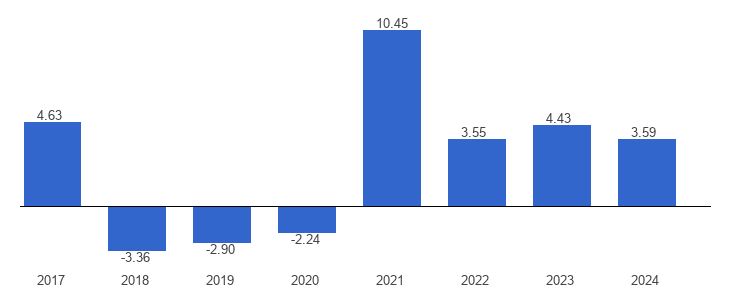
Economic growth: the rate of change of Nicaragua real GDP (source: https://www.theglobaleconomy.com/Nicaragua/economic_growth/
Stalin Vladimir Centeno, Stalin Magazine, November 22, 2025 https://www.tortillaconsal.com/bitacora/node/8066
The country enters the final stretch of the year with a budget that marks a turning point in national social policy. For 2026, 109 billion córdobas [$2.97 billion] are allocated to the fight against poverty, an unprecedented figure that reflects a sustained effort to strengthen social services with increased investment in education, health, infrastructure, energy, and productive programs. This amount far exceeds that of previous years and consolidates continuous growth that has allowed for expanded coverage, improved services, and the continuation of programs that directly impact families.
This fiscal stimulus coincides with an economic environment that remains dynamic in virtually all indicators.
Projected growth for this year is between 3% and 4%, sustained by domestic consumption, private investment, public investment, and a stable labor market with low unemployment rates. Cumulative economic activity continues its upward trend, with sectors such as commerce, services, transportation, construction, agriculture, and mining providing steady momentum to the production cycle.
Export performance is also experiencing one of its best periods. External sales are set to close this year at a record $8 billion, thanks to the boost provided by the general regime, which is advancing with increased agricultural, mining, and agro-industrial production, while free trade zones and services consolidate their expansion in various markets. The diversification of products and destinations has allowed for a stable flow of income that directly contributes to economic activity.
International reserves continue to grow, exceeding US$7.821 billion, a level that guarantees exchange rate stability and financial strength. The sustained increase in these reserves is associated with a greater flow of foreign currency from exports, demand for instruments denominated in local currency, and the dynamism of economic activity, which maintains a stable monetary equilibrium.
This behavior gives confidence to economic agents and sustains the use of the córdoba in more transactions.
The construction sector maintains significant growth that boosts the economy and generates thousands of jobs.
Private fixed investment saw a 33% increase in the first half of the year, driven by more residential, commercial, and industrial projects that boosted demand for materials such as cement, steel, paving stones, blocks, and ready-mix concrete. This sector has become a key driver of growth and reflects sustained confidence from both domestic and foreign investors.
Construction of the Coastal Highway is progressing with concrete achievements following the completion of the first 30-kilometer section between the El Naranjo border crossing and El Remanso Beach in San Juan del Sur. This section is part of the 119-kilometer first phase of this strategic corridor. This progress connects beaches, communities, and productive areas of the South Pacific, traversing 64 beaches and directly benefiting the departments of Rivas, Carazo, and Managua. The project includes 22 bridges and box culverts, is being built to high international quality standards, and has already begun to transform the tourism, commercial, and logistical dynamics of the coast. The project continues with sections 2, 3, and 4 currently under construction, consolidating a route that will open new economic and social opportunities for thousands of families.
The energy sector continues to strengthen with the expansion of the renewable energy mix. Between 2025 and 2026, an investment of US$1.25 billion is being implemented for solar and wind projects that will add more than 300 megawatts to the national grid. The country has successfully reversed its dependence on oil, which eighteen years ago accounted for 75% of energy consumption, and now generates between 73% and 75% from renewable sources—a structural shift that improves costs, stability, and sustainability.
Export activity at the ports confirms the expansion of production, with over 153,000 metric tons of cargo handled recently. This dynamism is supported by agricultural and agro-industrial growth, which continues to open new markets, such as the first export of peanut oil to China, in addition to shipments of processed wood, spirits, and other products that strengthen port activity and the logistics chain.
National production is progressing at a pace that is sustained month after month with results that confirm a solid agricultural and livestock cycle.
In the agricultural sector, 355,000 manzanas (approximately 105,000 acres) have been planted during the first growing season, with beans, corn, and rice forming the basis of domestic supply. Coffee cultivation is underway on 234,000 manzanas (approximately 104,000 acres) of Arabica and Robusta varieties, representing 97% of the annual target. Peanut cultivation is also progressing well, reaching 72% on 46,600 manzanas (approximately 106,000 acres).
Bean production exceeds 825,000 quintals, and rice contributes 495,000 quintals, while corn reaches 209,000 quintals. In the livestock sector, progress has reached 76% of the year's goals, with 627,000 head of cattle slaughtered and meat production exceeding 367 million pounds, supported by a cumulative growth of 9%. Milk production totals 281 million gallons, and the poultry sector adds 320 million pounds of chicken and 66 million dozen eggs, keeping domestic markets supplied. These results confirm that the country produces more food than it consumes and that the food surplus continues to be a determining factor for overall stability.
The country boasts a stable financial environment with 12% growth in deposits and credit, accompanied by adequate levels of liquidity and solvency. Commercial activity remains dynamic, with increasing sales in recent months and a domestic market responding positively to price stability. Inflation is holding steady at around 3%, supported by prudent monetary policies, targeted subsidies, and stable food prices that keep the cost of living manageable.
Tourism is experiencing a strong recovery with new air connections and more cultural events that are boosting the influx of domestic and international visitors. Tourism promotion is expanding with regional campaigns and cultural activities that reinforce the country's identity and enhance the appeal of its destinations.
Local governments are making steady progress on public works projects that benefit thousands of families with more streets, drinking water, sanitation, parks, lighting, and recreational spaces. These municipal investments are combined with national projects in education, health, sports, entrepreneurship, and property titling, strengthening legal security and economic opportunities in both rural and urban areas.
Exports linked to this production reflect a performance that drives the rest of the economy.
Agricultural, forestry, and fishing products total $2.677 billion, representing 85% of the annual target, with expectations of exceeding $3.175 billion by year's end. Coffee leads the way with $825 million, followed by beef at $682 million and sugar at $156 million, while peanuts are advancing at $86 million and consolidating their presence in new markets. Leveraging the strength of the general regime, free trade zones, and services, the country's total exports could reach $8 billion by 2025, the highest figure recorded to date.
This boost is accompanied by economic growth approaching 4%, inflation close to 3% and stable employment around 3%, sustained by the dynamism of trade, construction and credit which is advancing with a growth close to 12%.
The trend indicates that the country is moving forward with an expanding productive base and a stronger domestic market, responding to an environment of stability. None of this progress would be possible without a government that has defined the people as President and that maintains wise leadership under the guidance of Rosario Murillo and Daniel Ortega, always committed to the well-being of Nicaraguan families.
