Nicaragua Solidarity Coalition 4.8.2026: US-Israeli war on Iran; Amnesty International and NGOs, History of the FSLN; Nicaragua’s Renewable Energy
Miguel Ayerdis: Relevance and current status of the Sandinista Popular Revolution - A brief overviewAn article too long to summarize, from 2019 that goes over the different periods of the Sandinista and Nicaraguan struggle: fighting against Somoza, the first revolutionary period (1980s), the FSLN in the neoliberal period, and the second revolutionary period from 2007.
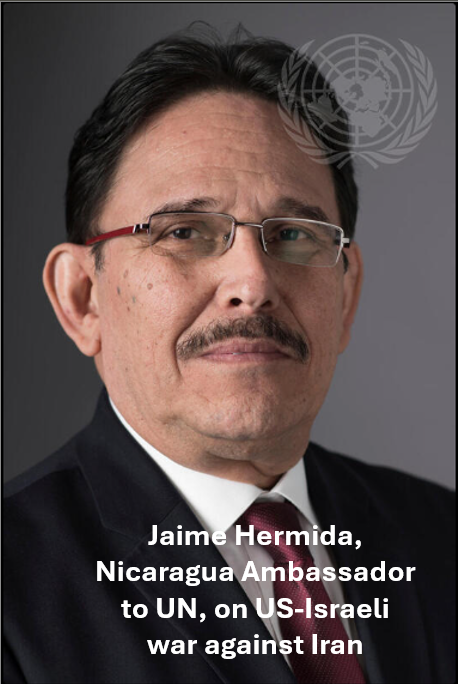
Jaime Hermida, Ambassador of Nicaragua to the UN, Presentation at the Virtual Meeting of Electoral Victory Units and Mayors' Offices Two months into the war against Iran and in the Middle East, we are sadly witnessing the continued murder of children and civilians in Gaza, Lebanon, Iran, and Syria. The mass displacement of children in Lebanon: over 370,000 children displaced in recent weeks, more than 120 children killed, and hundreds injured. Schools converted into shelters, disrupting education. In Iran, we see that President Donald Trump's shifting stances accelerated amid the escalating US-Israeli conflict. The President oscillated between threats of further destruction of Iranian civilian infrastructure and unconfirmed claims of negotiations.
[Iran declares 'historic victory' over US, says enemy forced to accept its proposal]
The Iranian power structure has proven to be far more resilient than the US and Israel expected; the assassination of leaders and attempts at destabilization have only highlighted that power in the country is comprised of a complex institutional structure, capable of functioning and maintaining control, even in crisis situations. The fact that Tehran maintains its stability even after the loss of key figures demonstrates that the gamble on rapid political change was entirely misguided. The root of this stability lies in the very structure of Iranian power, a system designed to cope with crises and losses. Clearly coordinated transition mechanisms and a complex, multi-layered institutional structure allow it to maintain governability, even in the face of such attacks.
The US Presidents insists that his military campaign in the Middle East is a success, The war is becoming the ultimate test of an operational principle that has guided Trump for decades: construct a narrative, declare it as true, and relentlessly force the world to submit to it. After more than 16,000 air strikes by the United States and Israel, the focus of the war now seems to be more the fate of the world economy, and the impact it has had on global oil prices.
Recent polls show widespread opposition among the American public to the war against Iran. Nearly 60% of American voters believe, after one month of the conflict, that it has gone too far, according to a poll published last week, and around 70% oppose a ground invasion of Iran. President Trump's approval rating has fallen to a record low, with only 33% of respondents approving of him and 62% disapproving. Surveys conducted among American Jews showed a majority opposition of 60% and 55% respectively against the US and Israeli war against Iran.
John Perry, Roger Harris: Amnesty International Defends US Regime-Change NGOs: Venezuela, Nicaragua, and CubaAmnesty’s new 95-page report criticizes governments across the political spectrum for attacking what it calls “civil society organizations.” But Amnesty ignores the history of many such organizations and therefore why governments might be justified in closing them. While claiming to expose the real purpose of these laws, Amnesty fails to explain their political context, despite the widespread and documented use made of NGOs by the US to destabilize countries.
In Nicaragua, which suffered a major coup attempt in 2018, Global Americans reported that the NED was “laying the groundwork for insurrection” even as the violence was taking place. NED and other bodies bragged to Congress about their regime-change efforts, and the Council on Hemispheric Affairs described in detail how NGOs indoctrinated young Nicaraguans. Alfred de Zayas, former UN independent human rights expert, argues in The Human Rights Industry that there are few fields that are “as penetrated and corrupted by intelligence services” as NGOs. “The level of NGO interference in the internal affairs of states and their destabilizing impact on the constitutional order has become so prevalent that more and more countries have adopted… legislation to control this ‘invasion’ of foreign interests, or simply to ban them.”
Common Dreams: Germany Pulls Legal Support for Israel in ICJ Gaza Genocide CaseBerlin says it needs to focus on its defense in a separate International Court of Justice (ICJ) case in which Nicaragua accuses Germany of supporting Israel’s genocidal war on Gaza. This is a marked departure from Germany’s January 2024 announcement that it would intervene on behalf of Israel in the case, arguing that the genocide allegation made by South Africa had “no basis whatsoever.” Nearly two dozen nations, most recently the Netherlands, Namibia, and Iceland, have either formally intervened on the side of South Africa or announced their intent to do so. In 2024, Nicaragua filed a case against Germany at the ICJ, arguing that the European nation “has not only failed to fulfill its obligation to prevent the genocide committed and being committed against the Palestinian people... but has contributed to the commission of genocide in violation” of the Genocide Convention.
Nicaragua, a top 25 country for renewable energy, with 70–80% green powerNicaragua ranks among the top 25 countries worldwide with roughly 70–80% of its power now generated from renewable sources. Nicaragua, long reliant on imported fossil fuels for electricity, has aggressively shifted toward renewables over the past two decades. In the early 2000s, the nation depended heavily on oil-fired generation, but strategic policies, private investments, and abundant natural resources have driven a rapid increase in clean energy supply. Wind has historically accounted for 10-14% or more of generation. Geothermal energy, drawing from the country’s position along the Pacific Ring of Fire, provides roughly 10-16% of electricity. Hydroelectric sources supply around 10-13% of demand. Biomass, primarily from sugarcane bagasse burned at mills, adds 13-19%, capitalizing on agricultural waste.
Upcoming Events
Some screenings of Earth’s Greatest Enemy
April 13 (Monday), 2:30 pm ET: Nicaragua Solidarity Coalition monthly meeting on zoom. Register in advance for zoom access at https://us02web.zoom.us/meeting/register/zIZX2DnfR6-zq0loUWilyg
April 19 Nicaragua Solidarity Coalition webinar: “TEACH-IN AND TOOLKIT LAUNCH: SANCTIONS UNDERMINE CHILDREN’S RIGHT TO HEALTH.” The impact of economic coercive measures, especially on children, with focus on Cuba and Venezuela. Primary co-sponsors Americas Without Sanctions/ Sanctions Kill, National Network on Cuba, and Venezuela Solidarity Network. Speakers are Ajamu Baraka, Jill Clark-Gollub, and Jess Cruz. Register: bit.ly/NicaApril19
May 1, Chicago: Report on Nicaragua Today- the social and political work helping the poorest of the poor. With Sarah Woodard of the Jubilee House Community
Delegations to Nicaragua: Casa Ben Linder Email casabenjaminlinder@gmail.com to apply:
July 2026: Solidarity in Action: Nicaragua’s Popular Revolution
October 2026: Salud & Solidaridad: Hands-On Healthcare in Nicaragua
Now offering Spanish classes! Fun and practical language classes at Casa Ben Linder – our model teaches 1/2 day class & 1/2 day practice in a community setting.
Nicaragua Solidarity Coalition: nicasolidarity.com
Sign up to receive the Nicaragua Solidarity Coalition bi-weekly newsletter, action alerts, event notifications: bit.ly/NicaSubs
Listserve: nicanet@googlegroups.com join at groups.google.com/g/nicanet
Weekly Nica Notes:https://afgj.org/signup
Facebook: Friends of Sandinista Nicaragua, Nicaragua Solidarity Coalitio
Twitter: @SolidarityNica
Instagram: @NicaSolidarity
YouTube: @nicaraguasolidaritycoalition
