Nicaragua Solidarity Coalition 8.6.2026: New Propaganda Assault on Nicaragua
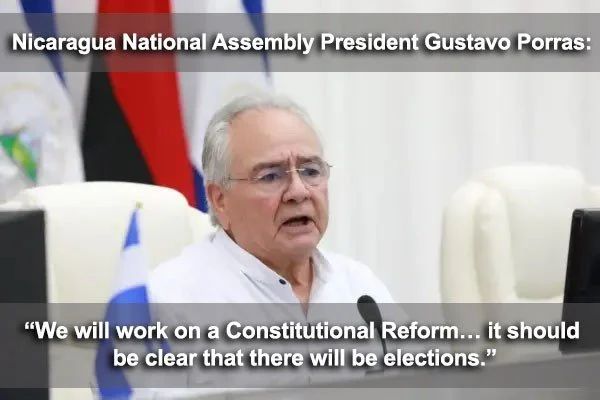
National Assembly President Gustavo Porras: Constitutional Reform on Elections seeks to Strengthen Democracy, Peace and Stability in Nicaragua Gustavo Porras clarified that the National Assembly is carrying out a constitutional reform process which aims to pass reforms on elections in early September.” We will work on a Constitutional Reform in relation to which it should be clear that there will be elections…. We are looking at Constitutional Reforms which allow us to ensure free, democratic, transparent elections, but ones with the conditions to guarantee stability, security and Peace, which are essential elements for combating Poverty…Part of the Reform is to do with those who exercise or have exercised the direction, leadership, financing, direct or indirect participation, or any type of connection with the planning, preparation or execution of an attempted coup d’état or a consummated coup d’état and will not be able to be candidates for positions of popular election, nor will they be able to hold public office by electoral appointment nor the Presidency.”
The Grayzone (John Perry): Nicaragua banned US-sponsored coup leaders from elections, sparking corporate media meltdown In his national address on July 19, Nicaraguan President Daniel Ortega stated that when the country’s next elections take place in 2027, none who promoted a violent anti-government insurrection in 2018 will be allowed to stand for office. The pledge was universally interpreted by Western media outlets as a total ban on voting, prompting hysterical interventions from the US State Dept and throughout South Florida.
Ortega proposed a blanket electoral ban on candidates who participated in fomenting the riots which plagued Nicaragua for months in a violent, US government-sponsored coup attempt which left hundreds dead. Quoting the President’s statement completely out of context, The New York Times shrieked that Daniel Ortega planned to abolish elections completely, strengthening his “authoritarian grip” on the country.
Washington’s plans for regime change in Nicaragua are hardly a secret, either. The National Endowment for Democracy’s president, Damon Wilson, bragged to a House committee in February that his organization is funding media in Nicaragua with an eye to undermining its Sandinista government.
Next-door Honduras provides a lesson of US electoral interference. Not only did Trump threaten Hondurans with aid cuts if they failed to vote as he wanted in last December’s poll, he also freed the convicted, narco-trafficking former president, Juan Orlando Hernández. To the horror of most Hondurans, he is returning to the country.
Secretary of State Marco Rubio’s statement supporting Trump’s address against foreign interference in US elections seems especially ironic in light of his escalation against Nicaragua. “Under @POTUS,” Rubio declared, “the Trump Administration will rout out foreign interference in our elections and safeguard our democracy. America’s future belongs to Americans.” Change the wording to refer to Nicaragua rather than the US, and you have a summary of what Daniel Ortega promised to Nicaraguans just two days afterwards.
Ben Norton (video): The US Is Manufacturing Consent For New War On Nicaragua Did Nicaragua really just abolish elections, as headlines from the New York Times to the BBC to the UN claimed last week? Ben Norton, host of the Geopolitical Economy Report, and fresh from Managua's 47th anniversary celebrations of the Sandinista Revolution, separates fact from a deliberately distorted quote. Ben explains that Daniel Ortega's speech, stripped of context, was not a renunciation of elections but a sovereign measure barring foreign-funded parties from contesting them, following the stolen election in Honduras and Gustavo Petro's accusations of US-Israeli interference in Colombia. We trace this back through the Contra war and neoliberal privatizations to Nicaragua's present accomplishments like free healthcare and education, low crime, and Chinese-backed infrastructure, as Marco Rubio names Nicaragua next in line after Venezuela and Cuba.
Stephen Sefton: The U.S. State Department Attempts to Rain on Nicaragua’s Parade Again In Nicaragua, free public medical care is the rule, and incidents of police violence, let alone lethal police shootings, are exceptionally rare. The country is categorically more secure and peaceful than most countries in the Americas, especially more so than its Central American neighbors, including Costa Rica where narcotics-related crime has increased greatly in recent years.
Nicaragua’s Sandinista Revolution has always been faithful to its vision of freeing Nicaragua’s people from poverty by promoting genuine economic democratization and social inclusion. Its solidarity-based national development model focuses on the human person so as to meet the needs and aspirations of all the country’s families, defending the wealth they produce and redistributing it to reduce poverty, prioritizing health care, education and new infrastructure.
Despite all the extremely adverse consequences of these various setbacks [the contra war, 16 years of neoliberalism, the 2018 attempted coup], Nicaragua’s economy has recovered thanks to economic policies focused on Nicaragua’s families, careful management of public sector finances, and appropriate, responsible use of available external funds. Judicious macroeconomic management, combined with the determination of Nicaragua’s families and the resilience of the country’s popular economy, made it possible to overcome the worst effects of the successive previous crises. The popular economy, mainly of small and micro enterprises, contributes about 70% of all employment in Nicaragua and about half of the gross national income. In general, estimates reckon that the country has increased its road network nine-fold compared to the one that existed in 2006. The same applies in relation to the coverage of electric energy that now covers more than 99% of the national territory and to drinking water access that now reaches more than 95% of the country.
As now Co-President Rosario insisted, on another anniversary, concerning the great victories achieved by the Sandinista Popular Revolution, “…all the Triumphs belong to the People, and as always in these days, and every day, I send an especially warm embrace to the families whose spouses, children, siblings, relatives in general, gave their lives so that we might have this dignified, free, harmonious, loving and patriotic nation, where we live together in peace, where we continue to cultivate reconciliation and affection, and where we seek to advance for the common good of everyone, with everyone, everyone together.”
Becca Renk Foster: Nicaragua to raise its voice for Palestine in another landmark ICJ case The World Court is set to hold public hearings in September on Nicaragua’s legal proceedings against Germany for aiding and abetting genocide in Gaza by providing weapons to Israel.
“Nicaragua expresses its unchanging solidarity with the heroic Palestinian people, who continue to face suffering, occupation, destruction and displacement perpetrated by the Zionist government of Israel and its occupying forces,” stated the Nicaraguan government on July 29th. The declaration condemned Israel’s renewed attacks, calling them an “unacceptable escalation of violence against the Palestinian people,” and repudiated “the continuous, growing violations of international and humanitarian law, as well as Israel’s attempts to criminalize the Palestinian population who seek only to protect their families, homes and livelihoods.”
The case Nicaragua has brought against Germany in the ICJ is also now being described as a “landmark case.” Nicaragua was unable to bring charges against the U.S. for aiding the Gaza genocide because the US withdrew from accepting the compulsory jurisdiction of the ICJ.
European Committee in Solidarity with the Sandinista Popular Revolution: Nicaragua, A Path of Dreams and Hopes, 40 years after La Zompopera, where our internationalist comrades fell “This is the most beautiful work I have ever done” — Berndt Koberstein, July 1986. Written just weeks before his life ended violently in Nicaragua, the whole statement speaks of death, but above all, it speaks of life; of lives condemned to poverty, of dreams that never come true, and of the need to fight so that every human being can have the opportunity to decide their own destiny.
Yvan Leyvraz, a Swiss man born in 1954, was 32 years old. He was a construction worker who had arrived in Nicaragua in early 1983. Joël Fieux, a 28-year-old Frenchman, arrived in Nicaragua in 1980 and decided to stay. He had studied micromechanics and worked in printing shops linked to anti-imperialist and anti-colonial movements in France. In Nicaragua, he participated in the National Literacy Crusade. William Blandón Aguilar and Mario Acevedo were Nicaraguans and were part of the local structure that made it possible for those projects to be something more than foreign cooperation. And then came the morning when everything for all of them changed. The morning of July 28, 1986.
Nicaraguan Foreign Minister Valdrack Jaentschke: We are witnessing the dismantling of the hegemonic imposition of the West According to the diplomat, although progress was made in dismantling the Western colonial model after World War II, the struggle now is to bury it definitively, as some of its elements persist, including "psychological and economic" ones. "It is clear that a new world must emerge that recognizes multilateralism, that recognizes the billions of people who live in what we call the global south."
"We have always faced foreign intervention, we have always faced interference in our internal affairs. And there is another actor that must also be highlighted, and that is the internal oligarchy. I think it characterizes in some way what Commander Daniel [Ortega] also said in the Plaza” on July 19. "In every country in Latin America, this oligarchy, which believes it has the right to maintain its hegemony and its imposition on our people, is allied with this foreign interventionist position. And we will not allow that either. We have always fought to defend our sovereignty, to maintain our self-determination, to defend peace," he declared.
Upcoming Events
August 10: Monthly meeting of the Nicaragua Solidarity Coalition at 2:30pm Eastern/ 11:30am Pacific time. Register in advance: https://us02web.zoom.us/meeting/register/jZv9KjYNQpyTxRZ-vgWRJA
August 18: Sanctions Kill monthly meeting. Email flounders.sara16@gmail.com for info
August 23, 3 pm ET webinar: Nicaraguan Foreign Minister Valdrack Jaentschke Preserving the Nicaraguan Revolution during the Neoliberal Years English and Spanish interpretation available. After losing elections in 1990, the FSLN vowed to “govern from below.” Over the next 17 years, 3 US-backed neoliberal governments privatized programs, and the poor suffered greatly. But the FSLN worked closely with its grassroots base to help people survive, organize, influence, and eventually return to power. The Co-Foreign Minister will give us an overview of this period.
September 3, 10, 17, 23: Governing from Below: Nicaragua During the Neoliberal Years A course comprising four 2-hour classes on Thursday evenings, to probe more deeply into the FSLN’s work following the loss of the elections in 1990. Nicaragua’s Frente Sandinista de Liberación Nacional (FSLN) vowed to “govern from below.” Over the next 16 years the FSLN worked closely with its grassroots base through unions, student groups, and social movements to influence the national government and eventually return to power. The FSLN’s experiences in opposition to neoliberal governance provide important lessons for activists around the world working to effect change.
Upcoming Delegations to Nicaragua:2027 Casa Ben Linder Nicaragua Tours
Feb 13-19 Bird Brigade – birding in Solentiname and Rio San Juan
March 6-14 Power and Protagonism: Women in Nicaragua – meet with women in leadership roles – cooperatives, labor unions, peasant feminists, and artisans to explore gender equity in Nicaragua
April 22-30 Light and Legacy: Ben Linder Brigade – Commemorate 40 years since the assassination of U.S. solidarity worker Ben Linder by U.S.-funded contra forces
May 21-June 1 Mayo Ya – Cultural tour to the Southern Autonomous Region of the Caribbean Coast, which is the heart of Nicaragua’s Indigenous and Afrodescendant communities.
Nicaragua Solidarity Coalition: nicasolidarity.com
Monthly meetings of the Nicaragua Solidarity Coalition are held on Zoom on the second Monday of each month at 2:30pm Eastern/ 11:30am Pacific time. The next meeting: Monday, August 10. Register in advance at https://us02web.zoom.us/meeting/register/jZv9KjYNQpyTxRZ-vgWRJA
Sign up to receive the Nicaragua Solidarity Coalition bi-weekly newsletter, action alerts, event notifications: bit.ly/NicaSubs
Listserve: nicanet@googlegroups.com join at groups.google.com/g/nicanet
Weekly NicaNotes (featured article & news briefs):https://afgj.org/signup
Facebook: Friends of Sandinista Nicaragua, Nicaragua Solidarity Coalition
Twitter: @SolidarityNica
Instagram: @NicaSolidarity
YouTube: @nicaraguasolidaritycoalition
