Sanctions Kill: Response Statement to US Government “Solidarity is not a Crime!” The State Department report – Cuba: the Capital of 21st Century Communism – inverts reality by blaming the victim. Washington has waged a hybrid war against Cuba for 64 years, including the 1961 Bay of Pigs invasion and current threats of military intervention. The report is a double-edged sword, threatening solidarity activists at home while providing further regime-change propaganda against Cuba. We commend the subpoenaed groups for their noncompliance with the Congressional committee’s orders: The People’s Forum, BreakThrough News, and Tricontinental: Institute for Social Research. Over 43 organizations are explicitly named in the State Department report. This encompasses many tens of thousands of individuals and projects. The Trump administration lumps genuine leftists, legal defense organizations, environmental groups and even the Democratic Party under the rubric of a communist threat.
Francisco Dominguez: Latin America Faces Growing US Aggression Recently, the US has scored substantial political victories through the election of right-wing administrations in several Latin American countries, including Ecuador, Argentina, Honduras, Bolivia, Chile, Peru, Colombia, Costa Rica, El Salvador, Panama, Paraguay, the Dominican Republic, Trinidad and Tobago, and Guyana. This represents a dramatic reversal of the political trajectory of a region that experienced the Pink Tide (1999–2016), when most governments were either revolutionary or progressive. By 2026, the region’s progressive governments are Brazil, Mexico, Nicaragua, Uruguay, Venezuela, and Cuba – a remarkable shift.
Trump’s military attack on Venezuela and the kidnapping of President Nicolás Maduro and Cilia Flores, First Lady and National Assembly member, on 3 January 2026 represents a dramatic escalation of the US aim to subordinate the entire Western Hemisphere to its political hegemony. This offensive has been broadened by a highly threatening and intimidating naval blockade against Cuba, which has prevented the supply of oil to the country for the past five months. The explicit aim of the US is to bring about its economic collapse.
Mexico and Brazil, especially the latter, are also in the US crosshairs. A principal reason for the aggression against Brazil is its status as a founding member of BRICS – a body that is not only growing in significance, influence, and membership, but which represents an objective challenge to Washington’s hegemony and its ability to weaponize its relations with the Global South.
Fidel Castro Speech in Managua, July 19, 1980 Because of a mistake in the last newsletter, here we post Fidel’s actual speech.
Webinar Recording, August 23 with Nicaragua's Co-Foreign Minister Valdrack Jaentschke: Survive and Organize: Preserving Nicaragua's Revolution during the Neoliberal YearsFollowing the loss of the elections in 1990, Nicaragua’s Frente Sandinista de Liberación Nacional (FSLN) vowed to “govern from below.” Over the next 17 years, three US-backed neoliberal governments privatized health care and education, thousands of people died before their time, and the poor got poorer. During this same period, the FSLN worked closely with its grassroots base through unions, student groups, and social movements to help people survive, organize, influence, and eventually return to power. Co-Foreign Minister Valdrack Jaentschke, provides an overview of these difficult years and how the revolution survived.
Transnational Institute: Cuba, Nicaragua and Palestine A Shared Struggle Against Colonialism and ImperialismThe solidarity between Nicaragua and Palestine can be traced back to the anti-imperialist struggle led by Augusto Sandino from 1927 to 1933. During this period, Ghadeer Abu Sneineh, a Colombian-born Palestinian, joined Sandino’s guerrilla army, seeing similarities between the impact that colonial powers had on Latin America and the impact they had on Palestine. After Sandino was executed at the hands of Somoza, Abu Sneineh travelled to Palestine to join the 1936 Arab Revolt against British colonial rule.
In the period leading up to the victory of the Sandinista Revolution, Nicaraguan and Palestinian ties were forged in shared struggle. For example, many Nicaraguan revolutionaries joined Palestinian forces during Black September 1970, in Jordan, where they paid with their lives. One prominent example was Patricio Argüello Ryan, a Nicaraguan and US national. In the 1960s, Argüello travelled across Latin America to see the Third World movements up close and eventually joined the FSLN. He later travelled to Jordan to train in Palestinian refugee camps. On 6 September 1970 he took part in an attempted PFLP hijacking of an Israeli plane, together with Leila Khaled. Khaled survived but Argüello was killed. The PFLP viewed Argüello’s sacrifice as a major contribution to the Palestinian cause and added him to its pantheon of heroes and martyrs.
Prior to the triumph of the Sandinista Revolution, the Palestinians trained several dozen FSLN members in Algeria and Lebanon. Among them were members of the future revolutionary government, such as Enrique Schmidt, René Vivas and Tomás Borge. After 1979, a PLO embassy was established in Managua and Yasser Arafat visited the country on 22 July 1980, consolidating the close bonds and diplomatic relations. The PLO reportedly sent up to 70 ‘high-ranking officials’ to train the Nicaraguan army and provided the new government with a 12 million dollar loan.
By the 1970s, Israel accounted for 98% of weapon imports received by the Somoza dictatorship in Nicaragua. Israel provided the Contras with weapons and training. A key role played by Israel in Latin America is as a provider of weapons and training to right-wing governments and dictatorships. Since the 1950s, this has included the dictatorships in Paraguay (1954–1989), Guatemala (1963–1966 and 1982–1985), Chile (1973–1990), Argentina (1976–1983), Ecuador (1976–1979), Nicaragua (1937–1979), and El Salvador (up to 1979, and during the civil war until 1992).
Drawing on its experience in bringing a successful case against the United States at the ICJ over the Contras war, Nicaragua has supported the cases filed against Israel at the ICJ with the aim of stopping the genocide in Gaza. This includes backing South Africa in its case against Israel under the UN Genocide Convention and filing its own case against Germany for ‘facilitating the commission of genocide’ in Palestine.
Both Cuba and Nicaragua recognise that to defend Palestine is also to defend those regions that have historically been colonised, and to resist capitalist and imperialist logics, including in Latin America. The Palestinian struggle against Israel’s colonialism is seen in Latin America as a reflection of the region’s own indigenous and popular struggles against the dispossession, extractivism, debt, and inequality that afflict the region.
The New Hampshire Gazette: Daniel Ortega, Elections, and the Context Western Media Won’t Print First, the elections. During his July 19th address commemorating the Sandinista Revolution, Ortega declared that the era of parties “installed by the Yankees” returning to government was over: “There will be no more elections, there will be no more [elections] through which they can try to seize the government, seize power.” He immediately called for laws erecting a “wall” or “block” against golpistas and vendepatrias—coup plotters and traitors—adding that “no matter how much money the Yankees give them, they will not succeed.” Western headlines performed emergency surgery and emerged clutching: “There will be no elections.”
Nicaragua has good reason to take American meddling seriously. During the Banana Wars, U.S. Marines occupied the country for much of 1912–33 in what historian Greg Grandin called the United States’ “first Third World quagmire,” until resistance leader Augusto Sandino won a war of attrition, sending occupation forces packing.
Coming Events:
September 2 Livestream Congressional Shadow Hearing (Wash DC): Moral and Legal Issues Related to the United States’ Blockade of Cuba Congresswoman Delia Ramírez, Congresswoman Ilhan Omar
September 2 (Wash DC): Solidarity is not a Crime! Code Pink
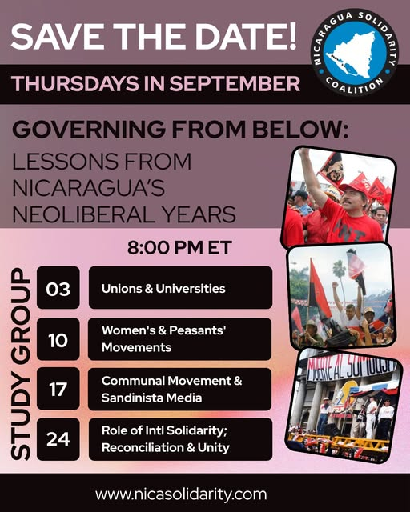
September 3, 10, 17, 23: Governing from Below: Nicaragua During the Neoliberal Years An online course comprising four 2-hour classes on Thursday evenings, to probe more deeply into the FSLN’s work following the loss of the elections in 1990. Nicaragua’s Frente Sandinista de Liberación Nacional (FSLN) vowed to “govern from below.” Over the next 16 years the FSLN worked closely with its grassroots base through unions, student groups, and social movements to influence the national government and eventually return to power. The FSLN’s experiences in opposition to neoliberal governance provide important lessons for activists around the world working to effect change. Email NicaraguaSolidarityCoalition@gmail.com for registration information.
September 13 (Britain, in-person event), No to Trump’s War on Latin America Francisco Dominguez, Venezuela Solidarity; Maria Perez Ramos, MORENA supporter, Mexico; Claudia Turbet-Delof, Wiphalas Across the World, Bolivia; Natasha Witham, NEU member of UK teachers’ delegation to Nicaragua, others.
September 27 (Britain, in-person event), No to Trump’s War on Latin America Gabriel Becerra, Pacto Histórico Party MP, Colombia; Francisco Dominguez, Venezuela Solidarity; Marcos Lagier, Argentinian anti-fascist campaigner; Julia Felmanas, Brazilian Workers’ Party; Conor Murphy, Sinn Fein Senator & Colombian election observer; Richard Burgon MP; Kim Johnson MP; John McDonnell MP.
Upcoming Delegations to Nicaragua:2027 Casa Ben Linder Nicaragua Tours
Feb 13-19 Bird Brigade – birding in Solentiname and Rio San Juan
March 6-14 Power and Protagonism: Women in Nicaragua – meet with women in leadership roles – cooperatives, labor unions, peasant feminists, and artisans to explore gender equity in Nicaragua
April 22-30 Light and Legacy: Ben Linder Brigade – Commemorate 40 years since the assassination of U.S. solidarity worker Ben Linder by U.S.-funded contra forces
May 21-June 1 Mayo Ya – Cultural tour to the Southern Autonomous Region of the Caribbean Coast, which is the heart of Nicaragua’s Indigenous and Afrodescendant communities.
Nicaragua Solidarity Coalition: nicasolidarity.com
Monthly meetings of the Nicaragua Solidarity Coalition are held on Zoom on the second Monday of each month at 2:30pm Eastern/ 11:30am Pacific time. The next meeting: Monday, September 14. To request the Zoom registration link, email NicaraguaSolidarityCoalition@gmail.com.
Sign up to receive the Nicaragua Solidarity Coalition bi-weekly newsletter, action alerts, event notifications: bit.ly/NicaSubs
Listserve: nicanet@googlegroups.com join at groups.google.com/g/nicanet
Weekly NicaNotes (featured article & news briefs):https://afgj.org/signup
Facebook: Friends of Sandinista Nicaragua, Nicaragua Solidarity Coalition
Twitter: @SolidarityNica
Instagram: @NicaSolidarity
YouTube: @nicaraguasolidaritycoalition
