Nicaragua, 47 years of the triumph of the Sandinista Revolution. “Power to the People!”
30 July 2026
By Javier Huerta
Translated from the original by Orla Mohally.
Forty-seven years on from the triumph of the Sandinista Revolution, the international media campaign is attempting to portray the defense of sovereignty as the ‘end of democracy’. From Sandino to the People-As-President. As we approach the twentieth anniversary of the second phase of the Revolution, Nicaragua is championing a model of democracy based on national sovereignty, popular participation and the collective pursuit of development.
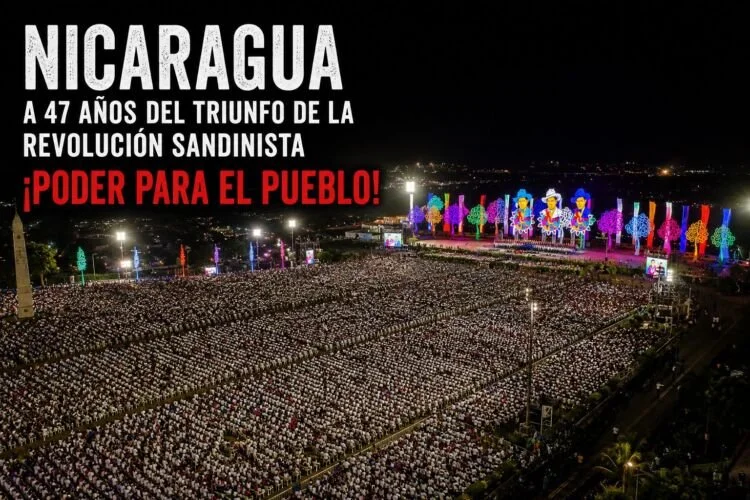
Power to the people: democracy, sovereignty and the battle for the narrative.
Until just a few days ago, this was going to be a commemorative article. My intention was to look back over the 47 years that have passed since that early morning of July 19th 1979, when the Sandinista National Liberation Front (FSLN) marched to Managua in victory and brought an end to more than four decades of the Somoza dictatorship. I wanted to write a chronicle of the evolution of the Popular Sandinista Revolution (PSR), of its two major periods in government, of the 17 years of resistance during the neoliberal era, and of the profound transformations Nicaragua has undergone since the Sandinistas returned to power in 2007.
However, the events that unfolded following the 47th anniversary celebrations mean that we must change our starting point.
Within a matter of hours, a clip lasting barely a few seconds from the speech delivered by Comandante Daniel Ortega had gone viral around the world. The phrase ‘Elections are over’ was reproduced by major international news agencies, television networks, newspapers and thousands of social media accounts as if it were definitive proof that Nicaragua had just announced the end of democracy. The rest of the speech – an address of over hour devoted to national sovereignty, the history of US interventions, the new multipolar landscape, the defense of Cuba and Venezuela, the role of organized civil society and the rejection of foreign interference – practically disappeared from media coverage.
This was not merely a matter of journalistic editing. What happened is an almost perfect example of the way in which many international political disputes are waged today. It is no longer enough to exert economic, diplomatic or military pressure on a country. In the age of instant communication, control over the meaning of words is also disputed. A ten-second video can circle the globe before millions of people have had the chance to hear or see the entire celebration. A headline can cement an interpretation that is unlikely to be corrected later, even when full transcripts are published or the protagonists themselves explain the context of their statements.
Speed has become a political tool. In the digital ecosystem, algorithms prioritize immediate impact over context; an isolated phrase takes precedence over the argument, emotion replaces analysis, and an image ends up overshadowing the story.
That is why, before answering the question of whether or not Nicaragua remains a democracy, it is worth asking another, much deeper and probably more uncomfortable question.
What do we really mean by democracy?
Because the real debate that has opened up since July 19th may not be whether Nicaragua will hold elections. The underlying issue is another: can democracy be reduced to the act of placing a ballot paper in a ballot box every few years, or must it also be measured by a people’s effective capacity to decide their own destiny sovereignly and guarantee fundamental rights to the majority of their population?
That question has been a constant feature of Nicaragua’s contemporary history since long before the revolutionary victory of 1979.
When Sandino organized the Army in Defense of National Sovereignty to confront the U.S. military occupation between 1927 and 1933, he was not merely fighting against a foreign presence. He was defending the ideology of the country. For the general, political independence was meaningless if major national decisions continued to be made outside Nicaragua. His struggle was not merely military; it was also a defense of popular sovereignty against any form of external control. That philosophy, which over time became one of the ideological pillars of the FSLN, remains present nearly a century later in much of Nicaragua’s political discourse.
Subsequent history seems to reflect that same tension. Following Sandino’s assassination in 1934, the Somoza family’s dictatorship took hold, sustained for decades by political, economic, and military support from the United States. For more than 40 years, Nicaragua held elections, adopted constitutions, and established parliaments, but real power remained concentrated in one of the continent’s longest-lasting dictatorships. That experience left a deep mark on the country’s collective memory: there could be elections without democracy, just as there could be formal institutions incapable of truly representing the will of the people.
That legacy explains why Sandinismo has historically insisted on an idea that many Western observers find unusual: democracy does not end when the polls close; it begins precisely the very next day.
From this perspective arises one of the political concepts most frequently invoked by the Nicaraguan government in recent years: the “People-As-President.” This is not merely a propaganda slogan, but rather the articulation of a specific way of understanding the exercise of power and democracy. According to this conception, citizen participation is not limited to periodic voting, nor does popular sovereignty end when the polls close. On the contrary, both are permanently manifested through neighborhoods, communities, cooperatives, local councils, and organizations of women, youth, and producers, as well as in the various spaces of popular organization that play a role in the country’s daily life. In short, it is a matter of an organized citizenry that actively participates in the day-to-day construction of the nation, expressing that sovereignty in the planning and development of schools, hospitals, cooperatives, roads, drinking water systems, electrical grids, universities, and social programs.
It can be shared or debated, but it is difficult to understand without bearing in mind that difference in the conception of democracy. As Nicaraguan journalist and analyst William Grisbypointed out in his reflections following the commemorative event, the controversy does not merely pit different political positions against one another; it pits two different definitions of democracy against one another. From that perspective, suffrage constitutes the starting point—not the end point—of the democratic process.
From Sandino to the People-As-President: A History of Sovereignty and Democracy
The PSR was not created merely to replace one government with another. It was created with the aim of transforming the very structure of the Nicaraguan state and restoring to the people the political, economic, and social agency that for decades had been held hostage by a family dictatorship sustained from abroad.
The victory on July 19th, 1979, found a country devastated by an insurrectional war, with high illiteracy rates, a massive concentration of land ownership, a healthcare system incapable of serving the majority of the population, and deep inequalities between rural and urban areas. The new government’s priority was to build a state where rights would no longer be privileges.
Barely a year later, more than 95,000 young volunteers participated in the historic National Literacy Crusade, traveling to the country’s most remote areas to teach people to read and write. In just five months, illiteracy fell from around 50% to just over 12%, an effort recognized by UNESCO as one of the most important educational campaigns of the 20th century. That campaign not only taught hundreds of thousands of people to read; it symbolized a way of understanding democracy in which popular participation became the driving force behind national transformations.
Along with literacy came agrarian reform, the expansion of public health care, mass vaccination campaigns, and the first elections held in 1984, in which the Sandinista Front won a landslide victory with the participation of international observers. However, the new project had little room to develop under normal conditions.
The Ronald Reagan administration decided to turn Nicaragua into one of the main battlegrounds of the Cold War in Latin America. The funding, training, and arming of the so-called Contras, the mining of ports, the economic embargo, and covert operations sparked a conflict that left tens of thousands of dead, caused enormous material losses, and forced the country to devote a large portion of its scarce resources to national defense rather than development.
In 1986 the International Court of Justice in The Hague rules against the United States for the illegal use of force against Nicaragua and for violating international law. Washington rejected the ruling and never paid the compensation imposed by the court, which Nicaragua later estimated at approximately $17 billion for the human, economic, and material damages suffered. That ruling remains one of the most important legal precedents in contemporary international law and continues to occupy a central place in the country’s political memory.
The toll of the war, the economic blockade, and the fatigue accumulated over a decade of conflict culminated in the 1990 elections. That election campaign took place under profoundly unequal conditions. Various studies estimate that the U.S. allocated approximately $200 million to provide political, economic, and media support to the opposition coalition (UNO), while the Sandinista Front conducted its campaign with far fewer resources, estimated at around $5 million. The U.S. administration itself presented those elections as a choice between the continuation of the war and the lifting of the economic blockade, or a change in government. The UNO, led by Violeta Barrios de Chamorro, brought together a diverse alliance of parties, but primarily represented the convergence of the interests of large business groups, a significant portion of the traditional economic elites and landowners, conservative sectors, and political forces aligned with Washington’s strategy to put an end to the revolutionary project that began in 1979. Contrary to most predictions, the Sandinista Front was defeated at the polls.
That night, Daniel Ortega uttered a phrase that would come to define the next seventeen years: “We will govern from below.”
That episode continues to be cited by numerous analysts, including Fabrizio Casari, as evidence that the Sandinistas accepted the election results even though they retained sufficient military strength to challenge them, prioritizing institutional continuity over any other political consideration.
Those elections ushered in a 17-year era of neoliberal governments that, between 1990 and 2007, promoted extensive privatization, reduced the state’s role in strategic sectors, and implemented economic policies advocated by the so-called Washington Consensus and international financial institutions. During this period, Nicaragua sold off public enterprises, the historic national railroad was dismantled, numerous services were transferred to private hands, and large segments of the population once again experienced a deterioration in their living conditions.
The tragedy caused by Hurricane Mitch in 1998—one of the worst natural disasters to strike Central America in the last century—further exacerbated that situation. Thousands of families lost their homes, infrastructure was severely damaged, and the country had to undertake a complex reconstruction effort amid enormous economic and social fragility.
When the Sandinista Front returned to power in January 2007, it found a very different country. Poverty continued to affect a significant portion of the population; only 54% of households had access to electricity, many roads remained unpaved, health infrastructure was inadequate, and thousands of rural communities remained virtually isolated for much of the year.
It was then that the political concept that would define the second phase of the Sandinista Revolution began to take shape: the “People-As-President.”
It was presented not merely as a change in government, but as a model that sought to combine macroeconomic stability, public investment, the expansion of social rights, and organized community participation in the country’s development. Democracy was no longer measured exclusively by the electoral calendar but was also sought to be expressed through much more tangible indicators: how many families had access to electricity, how many children could attend school for free, how many women held public office, how many kilometers of roads connected historically neglected regions for the first time, or how many small-scale farmers were able to increase their harvests thanks to credit, technical assistance, and government investment.
As British researcher Stephen Sefton points out, the Sandinista Revolution can hardly be understood as an episode that came to a close in 1979. It is a long-term historical process that has encompassed victories, defeats, wars, reconstruction, and profound social transformations, always centered on the same aspiration: the Nicaraguan people’s right to self-determination. From Sandino to the 1986 ruling in The Hague, from the resistance against the Contra war to the current rejection of sanctions and any form of foreign interference, the defense of self-determination emerges as the common thread linking the various stages of the revolutionary process. Beyond economic, social, or institutional changes, Sandinismo continues to regard national sovereignty as the essential condition for any democracy to develop effectively.
And it is precisely in the concrete results of that second period, which began in 2007, that Sandinismo today finds its main argument for maintaining that democracy can also be measured by what a people is capable of building collectively.
Democracy Is Also Built
There is a fundamental difference between the liberal conception of democracy that prevails in much of the West and the idea of democracy championed by the PSR. While the former tends to equate democracy almost exclusively with the periodic holding of elections, Sandinismo maintains that the right to vote is merely the starting point of a much broader process. For the Revolution, a genuine democracy must be capable of transforming the material conditions of life for the majority of the population. The vote grants legitimacy; social development gives it substance.
Not as a metaphor, but as a reality. A road means that a farmer can bring his harvest to market without losing it during the rainy season; that an ambulance can reach places it previously could not; that a student takes an hour to get to class instead of four; that an isolated community is no longer isolated. Concrete also builds citizenship when it connects historically neglected territories.
Two decades after the FSLN came to power, the national landscape has visibly changed.
Electricity coverage exceeds 99% of households, placing Nicaragua among the countries with the highest levels of universal access to energy in Latin America. But the change has not been merely quantitative. It has also been strategic. Whereas in 2006 the country depended almost entirely on imported oil to generate electricity, today nearly 80% of the energy produced comes from renewable sources—geothermal, hydroelectric, wind, solar, and biomass—reducing dependence on foreign sources and strengthening energy sovereignty.
The transformation can also be measured on the ground. Since 2007, more than 5,000 kilometers of paved roads have been built or rehabilitated, bringing the national road network to over 6,000 kilometers of paved roads, up from just around 2,300 kilometers in 2006. Added to this are dozens of strategic bridges—including the Wawa Bridge—that have permanently integrated large areas of the Caribbean Coast and the country’s interior with the rest of the national territory. These are infrastructure projects that rarely appear in the international press, but which profoundly change the daily lives of hundreds of thousands of people.
Over the past few years, Nicaragua has built and modernized hospitals throughout practically the entire country, expanding specialized care and bringing health services to regions that historically lacked them. Nicaragua has built 43 new hospitals over the past 20 years. The national public health network grew from 33 hospitals in 2006 to a total of 79 operational hospitals in 2026, establishing itself as the largest public hospital network in Central America. Health care is now understood as a right rather than a business.
Added to this is an extensive network of Maternal Wait Homes, recognized by international organizations for their contribution to reducing maternal and infant mortality. While many countries continue to experience enormous inequalities between urban and rural areas, thousands of Nicaraguan women have free access to prenatal checkups, accommodations, and specialized care prior to childbirth.
This transformation can also be seen in other social indicators. Between 2005 and the period leading up to the pandemic, Nicaragua steadily reduced both overall poverty and extreme poverty. According to data from international organizations and national institutions, overall poverty fell from around 48% to approximately 24–25%, while extreme poverty declined from nearly 17% to around 6–7%, one of the greatest advances in the country’s recent history. At the same time, access to drinking water and sanitation continued to expand through significant public investments. Drinking water coverage now exceeds 90% of the population, while sanitation services have expanded steadily in both urban and rural areas.
Education is another pillar of the model. The reinstatement of free education in 2007, the construction and renovation of schools, the expansion of public universities and technological centers, and vocational training programs have made it possible to significantly broaden access to knowledge. This is no coincidence. The Revolution has never viewed the literacy campaign launched in 1980 as a one-time effort, but rather as the first step in an ongoing policy aimed at democratizing knowledge.
Nor can economic transformation be understood solely by looking at GDP trends. Between 2007 and 2025, exports nearly tripled, while the Central Bank built up its international reserves. For much of the 2007–2018 period, Nicaragua also maintained macroeconomic stability recognized even by organizations such as the International Monetary Fund, prior to the crises stemming from 2018 and the pandemic.
At the same time, Nicaragua has intensified the diversification of its international relations. The strengthening of economic, technological, and cooperative ties with countries such as China, Russia, and Iran—along with a growing interest in cooperation initiatives promoted by the BRICS and the new multipolar world—also reflects a strategy of economic sovereignty. From the perspective of the Sandinista government, expanding its international alliances means reducing historical dependencies and gaining greater autonomy in shaping its own development model.
The smallholder and cooperative production model are particularly significant. Currently, about 90% of the food consumed by Nicaraguans comes from small and medium-sized domestic producers. Programs such as the Food Production Packages, Zero Usury, and loans targeted at rural cooperatives have sought to strengthen precisely this family-based economy, which guarantees the country’s food sovereignty and prevents excessive dependence on imports.
There is, moreover, an aspect that debunks many of the stereotypes built up about Nicaragua and which, paradoxically, receives very little attention in the major international media.
While numerous editorials portray the country as a supposed “patriarchal dictatorship,” the World Economic Forum has for years ranked Nicaragua among the world’s leading countries in terms of women’s political participation and gender equality. Female ministers, members of Congress, mayors, judges, police chiefs, university presidents, and community leaders are all part of a political reality that is hardly compatible with the oversimplified image often portrayed by the Western press.
This is no coincidence. Women did not simply join the Revolution after its victory. They helped make it possible. They fought against the dictatorship, organized neighborhoods, taught entire communities to read and write, and today they continue to occupy key positions in the country’s political, economic, and social leadership. Equality is not presented as a concession, but as a natural consequence of that historical process.
Added to all this is another indicator that also helps us understand the country’s transformation. In one of the regions most affected by drug-trafficking violence and organized crime, Nicaragua has for years maintained one of the lowest homicide rates in Central America and consistently ranks among the countries with the highest levels of public safety and perceived safety in the region. For millions of Nicaraguans, this reality is not merely an isolated statistic, but a condition that directly influences their daily lives, their mobility, economic activity, and the effective exercise of other rights.
None of this means that Nicaragua has solved all its problems. Economic and social challenges persist, as do the consequences of sanctions and the international context. But ignoring the transformations of the past two decades would prevent us from understanding why a significant portion of Nicaraguan society continues to associate these advances with the political project launched in 2007.
The latest poll by M&R Consultores placed the government’s approval rating at 88.5% and showed equally high levels of support for stability, public safety, and the country’s overall direction. These figures are part of Nicaragua’s political reality and help explain why Sandinismo continues to maintain a broad social base.
Regardless of how each reader may assess the situation, one fact is hard to dispute: the Nicaragua of 2026 is very different from the one Sandinismo encountered in 2007. That transformation is now one of the main arguments the government uses to defend its conception of the “People-As-President” and democracy. It is precisely in this context that the remarks made during July 19th ceremony,—which, just a few hours later, would spark an intense international battle over the narrative—must be interpreted.
Ceremony marking the 47th anniversary of the triumph of the Sandinista Popular Revolution. When an anniversary turned into a battle over the narrative.
Some anniversaries evoke the past, while others end up shedding light on the present. This commemoration of the PSR’s victory, held on July 19th, 2026 (see full video of the event), falls into the latter category. What began as a day of remembrance, celebration, and political reaffirmation ended up, just a few hours later, at the center of an intense international media battle. Not because anything extraordinary regarding the political trajectory of Sandinismo occurred in Managua, but because just a few seconds of the presidential speech were taken out of context and turned into the focal point of a completely different narrative.
From the early hours of the morning, tens of thousands of people began to gather in the Plaza de la Fe. Veteran fighters from the insurrection, mothers of heroes and martyrs, literacy brigade members, workers, peasants, students, representatives of social movements, and international delegations shared the same space with thousands of young people born long after 1979. That image encapsulated one of the day’s most important messages: the PSR was not presented as a memory of the past, but as a historical process that links generations and continues to look toward the future.
Co-President Rosario Murillo opened the event, setting the tone for the commemoration from the very beginning. Her remarks were marked by a constant call for peace, unity, hope, and confidence in the Nicaraguan people’s ability to continue shaping their own destiny. Rather than dwelling on the material achievements of recent years, she emphasized an idea that would run through the entire day: The Revolution can only be understood through the leading role of the organized people. That idea was summed up at the close of the ceremony when she stated, “All deeds, all glories, and all victories belong to the People”—a phrase that encapsulates the concept of the “People-As-President” developed over the past two decades.
Within this framework, Co-President Daniel Ortega took the floor. His speech traced the history of the aggressions suffered by Nicaragua, from the U.S. occupation and the resistance led by Augusto C. Sandino to the war imposed during the 1980s, the 2018 coup attempt, and the current forms of political, economic, and media pressure exerted on countries that defend sovereign projects. He also situated Nicaragua’s reality within an international context marked by the rise of a multipolar world and by the geopolitical disputes affecting Latin America.
In this context, Ortega warned that those who seek chaos continue to conspire to create instability; therefore, he reaffirmed his commitment to defending Nicaragua’s peace and well-being, and stated that anyone who attempts to disrupt that tranquility will be prosecuted to the full extent of the law. He also affirmed that he would not allow a repeat of the violent episodes experienced in 2018.
“Just because we’re not at war, don’t think we are at peace. No! They [U.S.-backed opposition] are continuously conspiring, trying to organize political parties, so that they can put up candidates and ensure those parties win the elections,” he added.
“Here is where we put an end to the idea that those parties put in power by Yankees, put in power by Somoza supporters, will ever return to government: never, never, never!” Said the Sandinista leader.
These quotes are crucial because they accurately convey the meaning of his words. Daniel Ortega did not announce the end of elections.
Following the presidential address, Darling Hernández, representing Nicaraguan youth, took the floor. Her remarks highlighted a particularly significant aspect: the generational continuity of the Revolution. She did not speak from the perspective of nostalgia shared by those who lived through 1979, but rather from the experience of a generation that came of age during the second phase of the revolutionary process. She affirmed the role of youth as protagonists in nation-building and advocated for a Nicaragua of peace, knowledge, innovation, solidarity, and social commitment. Her message conveyed a clear idea: The Revolution can only move forward into the future if the new generations also make it their own.
In a matter of hours, a clip lasting barely a few seconds overshadowed an entire speech that lasted over an hour. And a harmful media campaign began.
The first major media outlets to spread the interpretation that Daniel Ortega had announced the end of elections were The New York Times, CNN en Español, and the Spanish newspaper El País. Their headlines were quickly picked up by international news agencies, television networks, and digital platforms, establishing from the very beginning an interpretive framework that shaped much of the subsequent debate.
The controversy was not limited to the political interpretation of the speech. In an analysis published days later by American researcher and community development worker Becca Renk Foster, she cited observations by translator and interpreter Jill Clark-Gollub—a certified court interpreter in the United States—who noted that the meaning internationally attributed to Ortega’s words only emerged when the sentence was artificially interrupted before the speaker had finished his line of reasoning. According to Clark-Gollub, a professional translation must respect the full context of the speech and not isolate fragments that substantially alter the meaning of the message. The battle over the narrative—which implicitly highlighted that point—began right in the process of translating and interpreting the speech itself.
The political reaction in the U.S. was almost immediate; U.S. Secretary of State Marco Rubio stated in a tweet that “The Trump Administration and the international community will not stand bywhile the Murillo-Ortega dictatorship deepens repression at home and manufactures instability that threatens U.S. national security,” thereby endorsing the interpretation disseminated by the mainstream media.
Several analysts were quick to challenge that interpretation. American journalist Ben Nortondenounced it in response to Rubio’s tweet. Ben argued that the version put forward by Washington constituted a propaganda campaign that deliberately omitted the historical context of the speech. He pointed to U.S. funding of the Contras during the 1980s, support for the 2018 coup attempt, and Washington’s longstanding interference in Nicaraguan politics, concluding that Ortega was not announcing the end of elections, but rather his refusal to allow parties promoted or financed from abroad to return to power.
Along the same lines, journalist William Grigsby, in his reflections, insisted that the core of the president’s address was not the abolition of the right to vote, but rather the reaffirmation that Nicaragua would never again accept political projects subordinate to foreign interests dictating the nation’s destiny. British researcher Stephen Sefton interpreted the event as a new expression of the historical continuity of the project initiated by Sandino and consolidated in 1979, while Sputnik correspondent Victor Ternovsky highlighted the contrast between the narrative disseminated internationally and the reality he observed during his stay in Nicaragua, characterized—as he explained—by a climate of stability, security, and broad popular support for the revolutionary process. Along the same lines, Italian analyst Fabrizio Casari argued that the debate over the future legal framework for elections cannot be understood apart from the long history of U.S. interventions in Nicaragua and the state’s efforts to preserve its political sovereignty.
Institutional responses were not long in coming either. In the days that followed, Co-President Rosario Murillo publicly clarified that there would indeed be “elections yes—free, dignified, and sovereign,” insisting that the debate had never centered on the people’s right to elect their representatives, but rather on the rejection of any form of foreign interference in national political processes.
The president of the National Assembly, Gustavo Porras, echoed this sentiment when he confirmed that Parliament was already working on developing a new electoral legal framework aimed at adapting the legislation to the “People-As-President” model, strengthening institutional stability, and ensuring that no foreign power could ever again influence the sovereign will of the Nicaraguan people. Far from being an impromptu reaction, those statements were linked to the process of institutional reform initiated following the constitutional amendment, demonstrating that the speech delivered on July 19 was part of a broader political and legislative process.
Paradoxically, the international reaction ended up replicating the very phenomenon that the presidential speech itself denounced. While Daniel Ortega warned against any attempt to influence Nicaraguan political life from abroad, the initial interpretations circulated internationally led to intense diplomatic and media pressure aimed precisely at calling into question the future of the country’s political system even before the scope of the announced reforms was known.
Beyond the controversy it sparked, a question that has haunted Nicaragua for nearly a century resurfaced: Who decides the country’s future? For the Sandinistas, the answer can only lie with the Nicaraguan people themselves. That is why the debate that began after July 19th went beyond a discussion of specific statements to touch on a much deeper issue: sovereignty, the right of peoples to determine their own destiny, and the ongoing struggle for control over the narrative through which that reality is presented to the world.
Nicaragua Is Not Alone: Internationalism Continues to Defend the Sandinista Revolution
If the contemporary history of Nicaragua demonstrates anything, it is that every political, economic, or media offensive against the Sandinista Revolution has also met a response of solidarity beyond its borders. This was the case during the 1980s, when thousands of internationalists traveled to the country to participate in the National Literacy Crusade, work in agricultural brigades, build schools and health centers, or stand in solidarity with people resisting the war imposed by the Ronald Reagan administration.
That solidarity did not disappear with the end of the Cold War. It evolved. The challenges changed, and so did the ways of supporting the Nicaraguan people. While internationalism was once expressed by building schools or harvesting coffee alongside peasant cooperatives, today an essential part of that work takes place in a different arena: that of communication.
The controversy sparked by the July 19th event once again highlighted the extent to which information has become a new battleground for political dispute. In a matter of hours, a speech lasting over an hour was reduced to a single headline repeated by international news agencies, major television networks, and leading newspapers. Before millions of people could hear the full speech, a distorted interpretation had already spread around the world. In this context, reporting accurately, translating speeches correctly, contextualizing events, debunking disinformation campaigns, and offering alternative analyses is today a form of solidarity just as necessary as participating in a volunteer work brigade was four decades ago.
That new internationalism lives on through dozens of organizations spread mainly across Latin America, the United States, and Europe. Platforms such as the Nicaragua Solidarity Coalition in the United States, or the European Committee of Solidarity with the Popular Sandinista Revolution (CES-PSR), which coordinate numerous European solidarity committees, carry out information campaigns, organize brigades, international meetings, conferences, and forums for analysis aimed at raising awareness about the reality of Nicaragua today and the transformation taking place within the revolutionary process. At the same time, they work to combat the misrepresentation of information spread by the mainstream media and to denounce the threats, sanctions, and other forms of interference promoted by the United States and, on numerous occasions, supported by various European governments and institutions.
Alongside these platforms, political parties, labor unions, collectives, and solidarity networks in countries such as Argentina, Chile, Mexico, Italy, Germany, France, and Spain keep alive an internationalist tradition that, far from disappearing, has successfully adapted to new forms of political and media confrontation. Solidarity with Nicaragua thus continues to be expressed both through political and material support and through the defense of the Nicaraguan people’s right to explain their own reality and to sovereignly decide their own future.
Because the defense of Nicaragua’s sovereignty is no longer waged solely against economic blockades, sanctions, or military threats. It is also being fought on the front lines where international public opinion is shaped today: the realm of information. While certain centers of power attempt to impose a single narrative about Nicaragua, there remains an international network of journalists, researchers, translators, solidarity organizations, and committed citizens working to offer a different perspective and defend the Nicaraguan people’s right to explain their own reality in their own voice.
Over the course of nearly half a century, the methods of pressure have changed. So too have the forms of solidarity. But the principle that inspires them remains intact: no people should have their future dictated by the will of a foreign power. As long as there are attempts to intervene in Nicaragua’s destiny, there will also continue to be voices willing to denounce such interference and defend the right of Nicaraguans to freely choose their own path.
