NICARAGUA: A PATH OF HOPES AND DREAMS
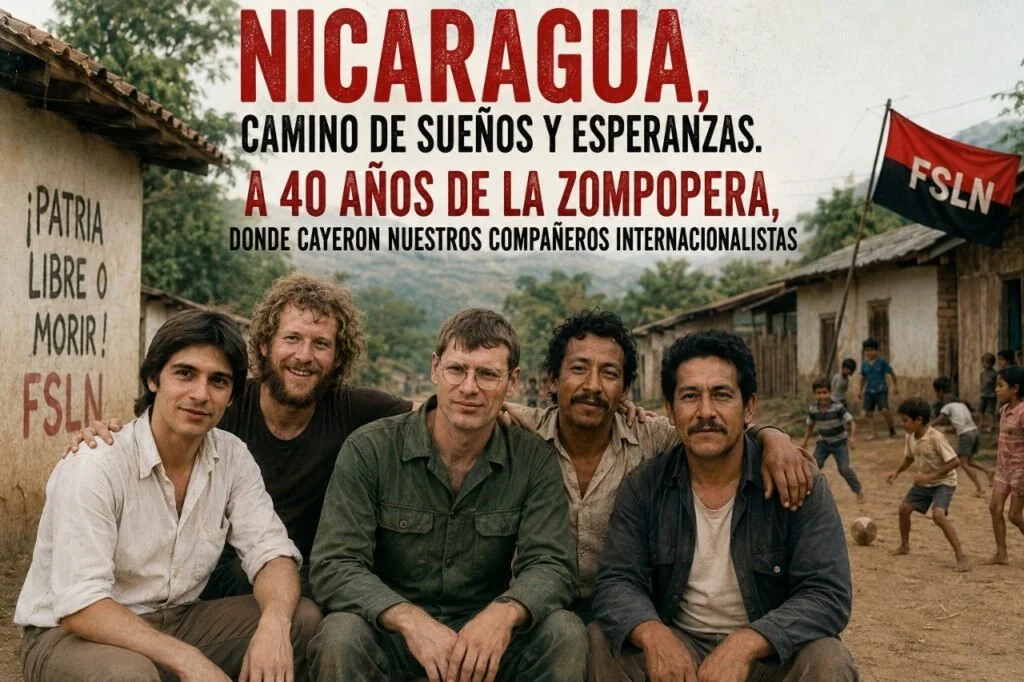
Forty years after La Zompopera, where our internationalist comrades fell.
By the European Committee in Solidarity with the Popular Sandinista Revolution
Translation from original by Orla Mohally.
Jul 28th, 2026
“This is the most beautiful work I have ever done in my life… the countless deaths that imperialism has caused in this and other countries are not its only crime; the millions of dreams it destroys, the many millions condemned to live in misery… that is a far greater crime.” — Berndt Koberstein, July 1986
There are phrases that outlive those who wrote them because they encapsulate an entire life. Written just a few weeks before his life came to a violent end in Nicaragua, he speaks of death, but above all, he speaks of life—of lives condemned to poverty, of dreams that never come true, and of the need to fight so that every human being may have the opportunity to determine their own destiny. When Berndt wrote that this was the most beautiful work he had ever done in his life, he probably never imagined that those words would end up becoming, forty years later, one of the best ways to understand why he, Yvan Leyvraz, Joël Fieux, and so many other internationalists decided to leave their countries and travel to Nicaragua to put their knowledge, their work, and their determination at the service of communities that aspired to a better life.
The Nicaragua they found after the victory of the Popular Sandinista Revolution on July 19th, 1979, was a country devastated by decades of dictatorship, poverty, and inequality. Rural areas lacked schools, health clinics, housing, roads, drinking water, and electricity. The Revolution set forth an immense task: to rebuild and, at the same time, bring rights and services to those who had been neglected for generations.
During that process, extraordinary international solidarity emerged. Doctors, teachers, technicians, builders, students, and workers traveled to Nicaragua to share their knowledge and efforts. Among them were three Europeans whose names would become forever linked to the northern part of the country.
Berndt Koberstein, a German from Freiburg, was 29 years old when he returned to Nicaragua in April 1986. He was a metalworker trained as an industrial mechanic, a union activist, and a communist militant. He had already been to Nicaragua in 1984 as a member of the Carlos Fonseca Brigade, which helped set up a printing press for the Sandinista Youth.
In 1986, he returned to Wiwilí to work on a potable water project. A pipeline about seven kilometers long was to carry water from a mountain stream on Kilambé Hill to the town, replacing the supply from the Río Coco, which was associated with health problems. The project, supported from Freiburg and Europe, was much more than just infrastructure to him. “This is the most beautiful work I’ve ever done in my life,” he wrote.
Yvan Leyvraz, a Swiss national born in 1954, was 32 years old. He was a construction worker and had arrived in Nicaragua in early 1983. He led work brigades, participated in the construction of a bridge in Matagalpa, and later organized Swiss-Nicaraguan brigades dedicated to housing and community projects. In Wiwilí, he worked on building homes for peasant families and, starting in 1986, in the El Cuá-Bocay area. His skills included construction, carpentry, and electrical work, which he shared with Nicaraguan workers.
Joël Fieux, a 28-year-old Frenchman, had arrived in Nicaragua in 1980 and decided to stay. He had studied micromechanics and worked in printing shops linked to anti-imperialist and anti-colonialist movements in France. In Nicaragua, he participated in the National Literacy Crusade, worked with peasants in the north, and put his graphic and technical skills to work for the revolutionary cause: he set up printing presses and communications equipment and produced materials, posters, and banners. He was married to Fátima Herrera and had a young son.
William Blandón Aguilar and Mario Acevedo were Nicaraguans and were part of the local infrastructure that ensured those projects were more than just foreign aid.
William Blandón Aguilar and Mario Acevedo, represented, from Nicaragua, another inseparable part of this story. They had not crossed an ocean; they were part of the very people who were trying to transform their reality. The joint presence of Nicaraguans and internationalists shows precisely what that solidarity meant: it was not a story of people coming from outside to do something for others, but a story of comrades working together—each drawing on their own experience—to help communities live better lives.
William, originally from San Miguelito, Río San Juan, was the Zonal Secretary of Propaganda and Political Education in Wiwilí and oversaw territories along the Río Coco. Mario, originally from Managua according to commemorative sources, was a member of the FSLN’s Zonal Steering Committee in Wiwilí and served as Zonal Executive for Government Affairs. I have not found reliable ages for either of them in the sources I consulted; I prefer not to make them up.
Thus, the five of them embodied something essential: solidarity was not a relationship between those who gave and those who received. It was a shared effort. A Swiss builder, a German working in the water sector, a Frenchman involved in communication and political education, and two Nicaraguans who were part of the local organization were united in a common task: transforming the living conditions of the communities.
But the Nicaragua they were trying to build was, at the same time, in the midst of a war. While some worked to bring water, education, healthcare, electricity, and productive projects to communities, others sought to prevent that process from taking root. The Contra war turned many rural areas into extremely dangerous places and directly affected the very populations that needed help the most.
Those internationalists were not entirely unaware of that reality. They had chosen to remain in a country facing an extraordinarily difficult situation because they believed that abandoning Nicaragua at that very moment would have meant renouncing the very meaning of their solidarity.
And then came the morning when everything changed. The morning of July 28, 1986.
The five of them were in Wiwilí and set out for Matagalpa. It was a trip related to their work: they were returning from an area where housing, potable water, and other social initiatives were being carried out. Historical records also indicate that they were involved in studies to manage new development projects for cooperatives and rural residents. The road passed through La Zompopera, a place that had already experienced the violence of war.
Around 11:30 a.m., two pickup trucks were attacked. The first managed to break through the fire; the second vehicle was hit. The occupants tried to hold out until the arrival of Popular Sandinista Army forces, but Berndt, Yvan, Joël, William, and Mario were killed.
The tragedy made La Zompopera a name inextricably linked to their five lives. But to reduce them to the manner of their deaths would be to allow violence to tell the whole story.
When we read Berndt’s words today, the “millions of dreams” he referred to were not an empty metaphor. They were the concrete dreams of people who wanted to live better lives, have access to education, have clean drinking water, have electricity, receive medical care, be able to work, and offer their children opportunities their parents had never had. Those were the dreams that those comrades had found in Nicaragua and had decided to help make possible.
They did not travel to Nicaragua to die. They traveled to work, build, teach, organize, print, bring water, build homes, and stand in solidarity with peasants.
That is why, forty years later, the legacy of La Zompopera can also be viewed from another perspective: through the transformations Nicaragua has undergone and through those needs that have gradually ceased to be dreams and have become concrete rights and services.
The dreams that kept moving forward
The FSLN’s return to power in 2007 made it possible to revive those dreams and ushered in a new era of public policies focused on expanding infrastructure and services. This does not mean that all problems have been solved; there are still communities and families in need. But the transformation is visible.
Electrification offers one of the most compelling examples. According to official data published by the Ministry of Energy and Mines in 2026, national electricity coverage reached 99.73%. Behind that percentage lies an enormous transformation: 10,192 electrification projects and approximately 11,201 kilometers of medium- and low-voltage grids, with initiatives spanning the country’s 15 departments, two autonomous regions, and 153 municipalities. The scale of this change becomes even more apparent when one recalls that around 2006, national electricity coverage stood at about 54%.
It is difficult to look at a figure like 99.73% without thinking about what it means for a particular family. It’s not simply that a light bulb can be turned on when night falls. Having electricity allows a child to study after dark, preserve food and medicine, access communications and technology, use tools, and engage in small-scale productive activities. When electricity reaches a remote community, it changes the possibilities for its residents and transforms that community’s relationship with the rest of the country.
Something even more symbolic is happening with water. Berndt worked in Wiwilí to replace a precarious water supply. Today, major drinking water and sanitation projects continue to be implemented. In 2025, for example, the expansion of the Jinotepe system included 73.2 kilometers of pipes, four reservoirs, and twelve wells to improve service for some 10,800 families. The 2026 Public Investment Program continues to prioritize drinking water, sewer systems, and sanitation as key areas of investment.
Education also reflects this continuity. In 2026, the Comprehensive School Nutrition Program will reach more than 1.2 million students, distributing food to ensure a daily meal at schools. This policy differs from the reality the international observers encountered, but it responds to the same underlying idea: that a child’s place of birth should not forever determine their opportunities.
In health, the expansion of the public health system continues with new hospitals, health centers, and specialized services. Among other projects, plans for 2025 included primary care hospitals in Corn Island, Granada, and San Rafael del Sur; a regional hemodialysis center in Estelí; and new specialized services at the Vélez Paiz Hospital. PAHO also recognizes recent progress toward a preventive, free, family-centered, and community-based health model.
We must not turn these figures into a story without contradictions. Nor can we know what Berndt, Yvan, Joël, William, and Mario would have thought if they had seen Nicaragua today. But we can affirm something simpler: many of the specific problems they encountered—water, housing, electricity, education, health care, and rural isolation—have been the focus of investment and transformation, and some dreams that seemed distant back then have become tangible services.
This is where the sixth protagonist of this story comes in: Nicaragua. Not as an abstract entity, but as the people and communities where those five men worked. Nicaragua was the place where their paths crossed, where solidarity ceased to be just a word and became action. And where we will always find warm, hospitable people, grateful for all internationalist solidarity.
Forty Years Later
Remembering them is a duty—not merely as an act of tribute, but as a duty of remembrance. They had names, families, careers, projects, and dreams. And they chose to put a part of all that at the service of others, in a country that was not their own, because they understood that solidarity could also be a concrete form of commitment in the pursuit of a more just and humane world.
